


A practical path to real AI value for mid-tier and brownfield mining operators, without matching Tier 1 scale or infrastructure.
Autonomous haul fleets, remote operating centers, AI models re-tuning mills in real time — these are the AI stories that dominate mining headlines, and they all belong to the industry’s largest producers. GlobalData counted more than 3,800 autonomous haul trucks in operation worldwide as of mid-2025, an 84 percent increase in a single year, concentrated in fleets across China, Australia, Canada and Chile.
For mid-tier and brownfield operators, that can make AI feel out of reach. In reality, it’s far closer than most realise.
Earlier generations of enterprise technology set a precedent based on a scale advantage: real value took large data-engineering teams and years spent getting the data just right, resources only the largest producers had. AI substantially weakens that dependency. MIT’s 2025 State of AI in Business research found mid-market organizations moving from pilot to full implementation in roughly 90 days, against nine months or longer for large enterprises. AI initiatives can begin with fit-for-purpose data rather than waiting for enterprise-wide perfection, allowing smaller teams to leapfrog stages that once required a major’s budget and headcount. The value doesn’t come from the scale of the technology. It comes from the discipline of the approach.
A well-designed AI initiative should do two things: deliver measurable operational or financial value, and leave behind a reusable capability that makes the next opportunity cheaper to pursue, like data connections, validated business rules or a structured knowledge base. The combination of value and capability is what separates a one-off pilot from progress that compounds.
Pick one real problem, build only what it needs
The strongest AI initiatives begin with the questions an operator already knows the answer to instinctively: Where is throughput being lost? Which decisions take too long? Where does maintenance run on tribal knowledge instead of data? Which forecasts go stale the moment conditions shift? Those questions surface friction operators already feel, which makes them more useful than asking where AI could theoretically be deployed.
Those areas of friction can be triaged by how directly they hit margin or throughput, starting with the clearest points of financial leakage in the value chain. The table below is a practical starting point, not a fixed list: every operation carries different constraints, so validate these against your own footprint, ideally in a cross-functional workshop, before committing to one.
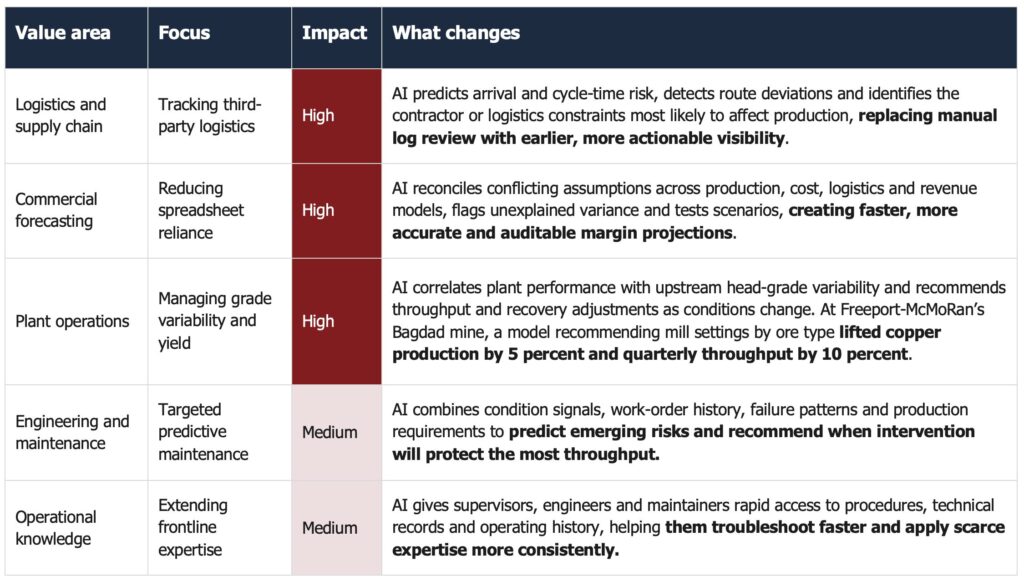
Pick one. Solve it narrowly, and make sure the foundation you build is reusable for the next one. That means naming the specific business process the problem lives in (i.e. plant scheduling, contractor invoicing or maintenance planning) and the metric that will tell you whether the fix actually worked (i.e. recovery rate, unplanned downtime or forecast variance). Framed that way, the problem also tells you exactly what you’re building toward, and how you’ll know it worked.
Most importantly, it frames the objective as a quantifiable operational problem to solve, immediately reflecting value.
Most pilots fail on approach, not technology
Most AI pilots do not fail technically; the model works. They fail organizationally. The same MIT research found that most enterprise generative AI pilots delivered no measurable P&L impact. Zooming in, these pilots had no clear ownership of the outcome, the value case was not quantified, or the output never impacted how people actually work.
Guarding against that doesn’t require an enterprise-wide data overhaul. It requires a minimum foundation across three things: the process the AI plugs into, the people who own the outcome, and the technology it actually touches.
Process
- The AI output must appear inside the workflow where the decision is made, not in a separate dashboard that operators rarely use.
- A feedback loop must show whether the recommendation changed the outcome, to improve the model over time.
People and governance
- An accountable operational owner must own the target metric and decide how the output will be used.
- Shared definitions and business rules must be agreed so the model is solving the same problem the operation thinks it is solving.
Technology
- The initiative needs access only to the minimum reliable data required for the use case, not a fully modernized enterprise data environment.
- The required data connections should be built so they can be reused in future applications.
Value builds through Target, Deliver, Scale
Each cycle creates a result and a reusable foundation for the next one.
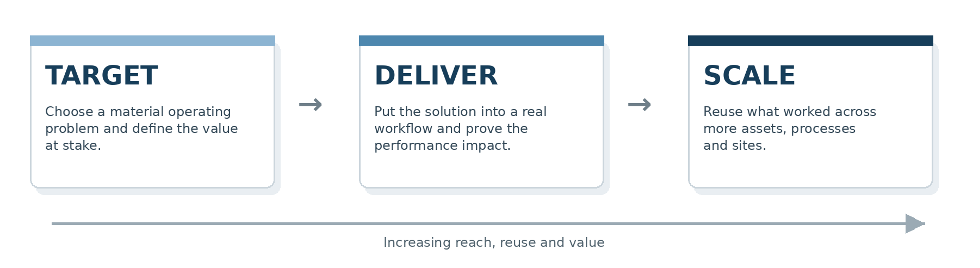
You do not need enterprise-scale capability to create value. In practice, each initiative follows the same rhythm: target a material operating problem, deliver the solution inside a real workflow, then scale what worked across the next asset, process or site.
Small wins compound into a stronger operation
Done right, these efforts stop being disconnected AI projects and start reinforcing each other: maintenance insight sharpens production planning, plant data informs mine decisions, a validated data layer makes the next use case cheaper to build than the last.
The benefit isn’t limited to operating margin. Mid-tier operators with structured, validated data foundations can also be more attractive to investors and acquirers: they scale more predictably, carry lower operational risk, and are less exposed to the labor constraints and cost inflation that weigh on manual operations.
When this happens, AI readiness is not an endpoint, but rather the byproduct of creating value, one well-chosen problem at a time.
The barrier to cross is not the technology. It’s knowing which problem to pick first, what foundation it needs to leave behind, and how to keep a pilot from becoming a dead end.
This article draws on the combined operational experience of Andersen Consulting and member firms collaborating through Andersen, including Clareo, Charter, Endeavor Management, Moyo and Mercurial Minds.