
Clareo’s Satish Rao is a contributor to Global Mining Review’s August 2026 edition. In “Lithium’s New Frontiers,” he details why the metal’s 2026 recovery is driven by far more than electric vehicles — and why the next supply wave may be led less by traditional miners than by the oil supermajors.
Demand beyond EVs
Lithium’s 2026 rebound of battery-grade carbonate back to the US$22,000–24,000/t range is usually read as an EV story, but in reality, the truer driver is grid-scale storage. Demand for lithium in stationary energy storage is forecast to grow 50–70 percent, while the build-out of AI data centres — projected to add around 300 TWh of US electricity demand by 2030 — is pushing hyperscalers toward solar-plus-storage behind the meter. Lithium iron phosphate now accounts for roughly 90 percent of all new global battery storage deployments.
From the shovel to the wellhead
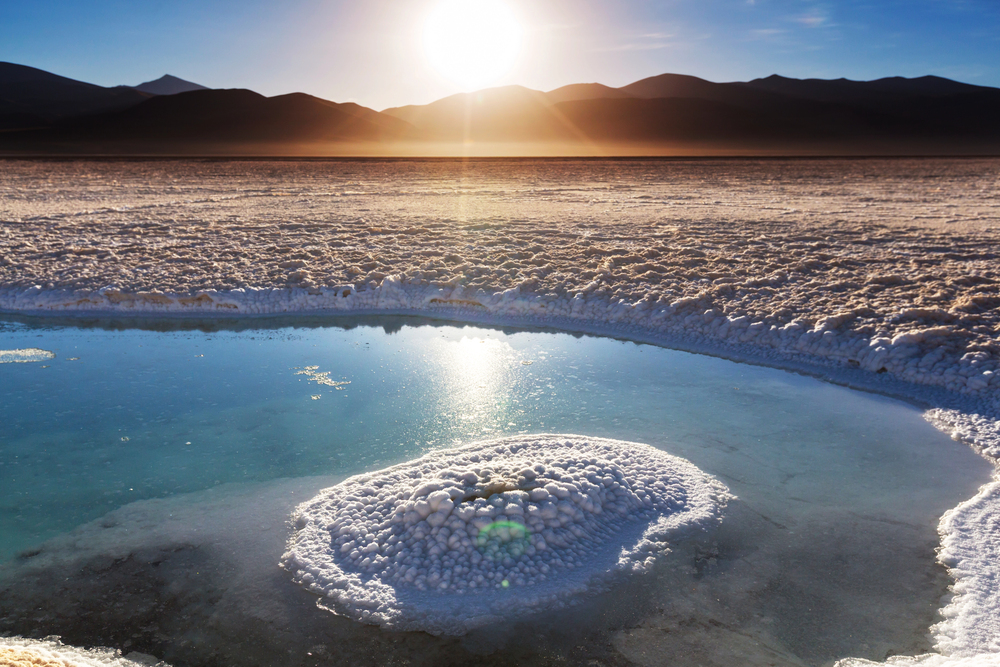
There is a sharp shift on the supply side. While lithium prices slumped, US oil majors have accumulated close to half a million acres of domestic lithium ground. ExxonMobil’s Saltwerx subsidiary won approval for a unified 56,000-acre brine production block in southwest Arkansas. Chevron’s interest is direct lithium extraction (DLE): a closed-loop, factory-like process that strips lithium from brine in hours rather than the 18 months a solar evaporation pond takes, then reinjects spent water underground.
Benchmark Mineral Intelligence expects almost three-quarters of new brine projects in the pipeline to use some form of DLE, reaching 14 percent of global lithium supply by 2035. The capabilities DLE requires, like subsurface reservoir engineering, deep-well drilling, high-pressure pumping and midstream chemical separation, are products of the oil industry, not the traditional miner’s.
Advantage will come from capability, not grade
The West faces a geographic mismatch: automakers and grids sit in North America and Europe, yet roughly 90 percent of lithium extraction and processing sits on the Australia–China axis and in South America. US Foreign Entity of Concern and Section 232 rules make domestic, lower-carbon supply, like Nevada clays, the Smackover and Rhine brines, strategically essential.
The report’s conclusion is that competitive advantage in the next wave will be defined not by the highest geological grade, but by the ability to master cross-industry convergence: continuous-flow chemical automation, regionalised supply chains, and the energy transition treated as an advanced engineering discipline. Hard-rock, continental-brine, claystone and unconventional-brine players each face a distinct imperative to adapt or be left behind.
For miners, energy majors and policymakers alike, the lithium map is being redrawn by capability as much as by geology — and the window to build the right capabilities is now.
You can register for free to read the full article in the August 2026 edition of Global Mining Review.